Part II to Bow:The Rising is up! Plenty more to come. We're all itching to get out! Hope this gets you feeling the same.

Showing posts with label Fly Fishing Calgary. Show all posts
Showing posts with label Fly Fishing Calgary. Show all posts
Friday, February 4, 2011

Thursday, September 24, 2009
Bull Trout After School
Here's a few pictures sent in from a couple fishing buddies.
They headed out to a "secret location" looking for some bullies.
They headed out to a "secret location" looking for some bullies.
.

.
 .

-Nice pics guys, thanks for the email!
Sunday, September 20, 2009
BWO- a look at blue wings and olive bodies

Insects are the most common class world wide, nearly one million species are known to date and some scientists speculate we haven't even scratched the surface. Its no wonder we're all a little confused or have misconceptions when it comes to bugs. Most of our problems come from simple misnaming. When it comes to Blue Winged Olives, this often occurs . Often a genus like callibaetis is referred to as a Baetis, when in fact it is a Baetidae (a little harder to say but it's much more scientifically correct.) Below is the nomenclature for those that find it easier to understand. Baetis, Callibaetis, Cloeon and Pseudocloeon's are all in the family Baetidae and are collectively referred to as Blue Winged Olives. Within the family of Baetidae lies over twenty separate genus's and again most of us refer to all of these as BWO's.
Kingdom Animalia (Animals)
......Pylum Anthropoda (Arthropods)
................Class Insecta (Insects)
........................Order Ephemeroptera (Mayflies)
..................................Family Baetidae (BWO)
....................................................Genus Baetis
....................................................Genus Callibaetis
....................................................Genus Cloeon
....................................................Genus Pseudocloeon
....................................................(many more!)
And enough of the stupid science, lets talk applicable science. If you would like to become confused I highly recommend investigating this subject further. The multitude of genera and diversity between them can make for an interesting study, I recommend the resource I used here, called "Mayflies. An Anglers Study of Trout Water Ephemeroptera" (see reference at end of blog.)
Baetidae are found throughout North America but predominate in weedy and nutrient rich waters. The nymphs will populate any body of water (stream, river, lake) that offers a cool, suitable environment. They can range from slow sections of freestone rivers to fast sections, gravel runs and riffles to slow moving spring creeks and among shoreline weeds in lakes. The nymphs are excellent swimmers due to their movement that actually resembles a minnow. They are usually pale to dark olive bodied and can vary greatly. Mature nymphs have dark, well developed wing cases and their legs darken to an olive brown.
When ready to emerge, the nymphs swim or float to the surface and shed the nymphal shuck. The surface film provides a huge barrier to the tiny insects, and many never pass through. Those that do must sit on the surface to allow their wings to dry and become rigid allowing them to fly away. During cool weather this takes longer to occur, so duns will float for greater distances on the surface. It is important to note that the naturals float very low in the surface film, with their bodies and tails flush. During this stage we can also fish cripple BWO's.
The Dun (sub-imago) sports two large sail like wings that point upwards and have blueish, grey coloring that can range from light to almost black. Typically within six to twenty four hours following emergence (highly temperature dependent) the duns molt into spinners (imago). If the emergence occurs in the morning the spinner fall usually occurs in the evening while if the emergence is in the afternoon then the fall will probably occur the next morning. Female spinners are usually identical to the duns but males have much lighter bodies, sometimes almost white. During this final molt the wing veins become highly visible called hyaline. After fertilization, the females enter the water after remaining on the stream side for the eggs to ripen, then deposit their eggs on submerged logs or vegetation, and then are washed away. Rarely, the males accompany the females.
Much variation occurs throughout the generas and the following are some of the deferrals from the above information.
The Baetis Genus nymphs often congregate around weed beds or crawl up plant stems when emerging, though they can still emerge in the normal Baetidae form. Nymphs usually have markings or stripes that are paler than the other body segments. The female Duns are often brighter while the males are more subdued and the spinners have green females and brown males- the spinner fall occurs during the evening.
Callibaetis commonly called the speckled dun, are seen often in Alberta. They prefer lakes or very slow sections of river, so we will find them on the Bow River. Nymphs vary in color greatly, usually taking on the color of their surroundings and have long, slender bodies. The nymphs congregate under weed beds and once out of the surface film usually take only a few minutes to become air born as a subimago, their wings usually have a predominant white vein pattern. The most productive hatches occur on cool, cloudy days when the duns must remain on the water for greater periods of time.
As most of you know, there is a great amount of indecision and scrutiny that occurs in the field of entomology, if there are any mistakes in this writing please let us know. It is better to be proven wrong and be corrected then to be documenting inaccurate information! Your help is greatly appreciated.
All information was taken from either:
-http://www.troutnut.com/hatch/90/Mayfly-Baetidae-Blue-Winged-Olives taken Sept. 20, 2009.
-"Mayflies. An Angler's study of Trout Water Ephemeroptera" Written by Malcolm Knopp and Robert Cormier. Lyons Press (Guilford, CT) 1997.
Picture from:http://images.google.com/imgres?imgurl=http://www.onlinefishinglog.com/images/blog/2006_outdoors/blue_winged_olives.jpg&imgrefurl=http://onlinefishinglog.com/blog/8/Outdoor-Pictures-2006&usg=__N_9amYwLOaI1EsaSSdmqhmrkMeI=&h=600&w=800&sz=54&hl=en&start=17&sig2=BOGRLkWhS9QXyg_45Q9ZkA&um=1&tbnid=kkcsuRg5eafeYM:&tbnh=107&tbnw=143&prev=/images%3Fq%3Dblue%2Bwing%2Bolives%26hl%3Den%26rls%3Dcom.microsoft:en-ca:IE-SearchBox%26um%3D1&ei=qGi2SpbnMYLUsQOjh6XSDA
Thursday, September 17, 2009
Fishing Knots
Knots, the dreaded knots. For some of us its a cinch (no pun intended) and for others it's the worst part of fishing. Whether it's tying on tippet, or trying to string up that size 18 Trico, it can ruin a perfectly good day on the water.
Every fisherman has their own special knot or combination of knots for their system but here's what I feel is one of the easiest combination (from reel to fly), to simplify and reduce the amount of time you spend fumbling around with mono-filament, fly line and backing.
Reel to Backing- Arbor knot

To tie the arbor knot, wrap the backing around the reel spool and tie an overhand knot around the standing line (labeled main line) then tie a second overhand knot on the tag end. Keep in mind that this is the least important knot of your entire system, it will only need to be done once (for the life of the backing which should coincide with the life of the reel) so don't spend alot of time practicing it.
Backing to Fly Line- Albright Knot
This may seem like a nasty little knot but keep in mind if your struggling a local fly shop will probably be more than happy to tie it for you. It, like the arbor knot, will not be tied regularly since it will only have to be done once per the life of your fly line.
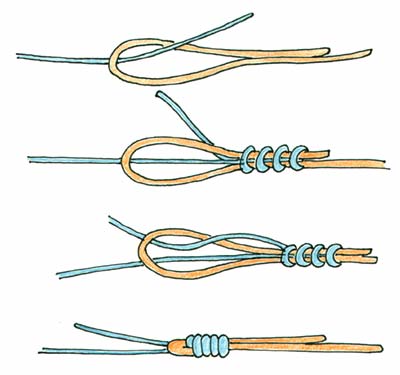
To begin, wrap the fly line around itself to create a loop and run the backing through the loop (image one.) Wrap the backing around the double strands of fly line backwards (towards the loop) approximately seven times (this diagram shows four wraps.) Now take the tag end of backing and place it through the loop of fly line (diagram three.) Now this is where a lot of people go wrong, there are two directions that the tag end of backing can go through the loop. The tag end must go out the same way it came in! For example in diagram three you can see that both ends of backing (in blue) end up on the same side of the fly line (yellow), if the backing was run through the loop in the opposite (wrong) direction then the two pieces of backing would end up on either side of the fly line. Once you have completed step three, all you have to do cinch up the knot so there isn't a lot of gap between the end of the wraps of backing and the end of the loop of fly line then pull gently on the tag end of backing, followed by pulling gently on the standing end of backing, alternate doing this until the knot is tight and secure. To finish, clip off the tag end of backing and the tag end of fly line.
Fly Line to Leader- Loop to Loop
Yes the loop to loop, for those that haven't heard it will reduce your knot tying time likely by half, no more nail knot! This knot is extremely simple, all you need is both the end of the fly line and the leader to have a loop. Both commonly come manufactured this way.

Take the fly line and pass it through the loop of the leader, now take the end of the leader and pass it through the loop of the fly line. Tighten up the knot and you have created a square looking, loop to loop knot. To reverse simply push the loops together to loosen then reverse the steps above.
Leader to tippet- Surgeons Knot

This knot is basically a double stranded overhand knot that is wrapped twice through the loop (not once.)
Overlap your leader and tippet material so you have a double strand, then make a simple overhand knot (image one.) Instead of tightening at this point, wrap the double strand through the loop once again (image two) and then tighten (image three.) Clip off the tag end of leader and the tag end of tippet.
Tippet to Fly- Clinch Knot

Thread the tippet through the eye of your hook, if you have trouble many gadgets called threaders exist that can help you do this. Wrap the tag end around the standing line six to eight times. Now you have made a loop back at the eye of the hook (image two), place the tag end through this loop and hold on to it. Pull on the standing line to tighten the knot, then clip off the tag. Important: do not pull on the tag end to tighten the knot, this will you give you a false knot. It will look right but will easily come undone producing a curly end commonly called a pigs tail when it does. If you see this pigs tail it is an immediate indication that you pulled on the tag end not the standing end.
Notes:
Terminology- Tag end refers to the end of material that is extra and has no purpose, it is usually clipped off. Remember not to clip it off as tightly as possible in order to give a bit of extra room for slipping.
Standing end refers to the end of material that is being used to connect.
***When dealing with materials such as mono-filament and fluorocarbon, they must be moistened before tightening. This is because as the knot is tightened it creates large amounts of heat that can weaken your perfectly tied knot. The easiest way, spit on it!
Hope this helps with your knot troubles, and if your still having trouble CP staff is more than happy to give you some instruction.
-C.
Saturday, August 22, 2009
Guide Spotlight - Mike Guinn
September is approaching quickly and our summer is fading, it won't be long till we have to bring out the shovel and winter tires! Make the most of our few remaning days of summer, get out and fish! Whether your a seasoned angler or trying to get into fly fishing, a guided fishing trip can be a valuable experience. A catch of Bow River Rockets and Buttery Browns make the Bow River famous and with good reason.
We employ who we think are the greatest guides in Calgary, and the comments we recieve post-trip have been beyond confirming those beliefs. Our outfitting service employs a handful of exclusive Bow River guides that can be your tour guide to our home waters. Our trips include a full day on the river, a shore side deli style lunch, a variety of beverages and gear if you require it.
 Mike with a nice brown and a happy client.
We'll start our guide spotlights (more to follow) with possibly one of the most experienced guide on the river, Mike Guinn.
Mike has been guiding on the Bow River for over thirty years, his experience holds him in high regard in the guiding industry. We'll let our clients comments tell the story.
"Mike was great, very knowledgable and helpful. It was an honor to have been guided by him."
.
- Neil Johnson
.
"Mike was great! He was extremely knowledgable, lots of fun and had tons of helpful hints and advice. [He] knew the river very well and made the day very enjoyable. We got into lots of fish and [his] feedback and help made the day more productive and fun."
.
- Cam Woolnough
.
"I was very impressed with the quality of fishing on the river and more so with the guide, [Mike Guinn]."
.
- Mike Trainor
If you'd like to fish with Mike or any of our other exclusive, experienced fishing guides time is running out. Bookings can be made via email, over the telephone or in store at:
Country Pleasures Fly Shop and Outfitter.
403-271-1016
#100 Willow Park Village
10816 Macleod Trail South
Calgary AB
info@countrypleasures.com
Stay tuned for more guide spotlights!
Thursday, July 30, 2009
Cutthroat continuation
Oncorhynchus clarki
.

.  .
 .
. .Note: A High Stream Temperature advisory was placed between Rocky Mountain House and the Montana-Alberta border on July 28, 2009. Please choose to avoid streams where the water temperature rises above 22º C, carrying a water thermometer can come in handy.
Even if the water temperature is below 22º C please use caution when fishing, taking extra care when fighting and releasing fish to minimize stress.
More information can be obtained at:
-C.
Subscribe to:
Posts (Atom)